Monday, May 31, 2010
A Different Kind of Graduation
A Charlotte Mason Nature Study Group

Have you thought about forming a Charlotte Mason Nature Study Group or Co-op?
It has been a wonderful blessing for our little group in so many ways. We highly recommend it.
Every group is different and will have a flavor all its own depending on its members.
Here are some of the things that have worked well in our group:

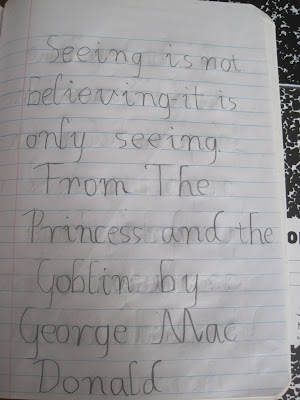
Nature Journaling
This is the one thing we do consistently on a weekly basis.
This is what we wish to do for children in teaching them to draw - to cause the eye to rest, not unconsciously, but consciously, on some object of beauty which will leave in their minds an image of delight for all their lives to come. ~Vol. 1 p. 313
Recitation
We aim for the children to recite once a month. We let the children pick a poem of their choice from a selection of our choosing. Some children memorize it, others read it - we leave it up to the individual families to decide what is best for them.
An accepting and encouraging environment is obviously important being that it can be intimidating to speak in front of others, some personalities struggle with this more than others. Overcoming the fear at first is a good beginning goal. If they are working on memorizing it, it's good to give them ample time to do so because the goal of recitation is not to memorize, but to learn to speak well in public and "to find the just expression of thought for himself."
(Although, I will admit there were a couple of times we memorized the last stanza in the car on the way to Nature Study! I apologized to them profusely and helped them with any lines they may have forgotten during their recitation.)

Foreign Language
We did this through a short song or quick game like duck, duck goose in Spanish, rock paper scissors in Japanese, role-playing shopping in French, etc.
Art Lesson
We've had quick art lessons (thanks, Jen for all the great lessons you've put together for them!) like . . . sketching - use a sharpie or a soft graphite pencil (no erasing!) and use quick strokes to draw a thing, keep the hand moving.
Or, shading - take one color, add white for a lighter tint, brown or black for a darker shade; use all three colors because even though a bird is blue, there are shades. A leaf would be great for this also.
Bird beaks - See all the shapes of birds beaks? Look at the birds you see and only draw their heads, paying special attention to their beaks. Use hatching (fine, parallel lines drawn close together) to create shading or texture.
Every now and then we like to mix things up or attend something that sounds interesting or fun - the farm for colonial days, museums, the aquarium, a musical performance at the local university, Olvera St. and Chinatown in Los Angeles, the community mud park, the Japanese grocery/department store, kayaking, etc.
Another CM nature group recently had a bake sale and contributed all the funds to the wetlands conservatory - isn't that a great idea!? It's expected coming from a wonderful group like theirs. :)
For the most part, we just take them out in nature and let them be.
We give them free, unstructured time to explore, discover, create, and mainly 'be in touch' with nature.
In the beginning, it took a little time for all of us to learn 'Masterly Inactivity,' which works best when your child is well trained (see here for help in that department). Now, we are able to enjoy our time discussing a book or talking with very little incident arising from the children.
The mother who takes pains to endow her children with good habits secures for herself smooth and easy days; while she who lets their habits take care of themselves has a weary life of endless friction with the children. ~Vol. 1, p. 136
Some of the books we've enjoyed as a group include topics like: child training, theology, being a better mother and wife, homemaking, literature, etc.
The nature of a CM education is that we are learning along with our children, and we often find ourselves discussing the books, art, music, etc. that we learn along with our children.
Since our particular group uses the Ambleside curriculum, some of us may add some reading from a living book on the topic for the term (wildflowers, trees, insects, etc.) or play audios (free downloads available from http://www.librivox.org/ - john burroughs, arabella buckley, Fairy Book of Science, etc.) so that they learn about the subject through living books.
We may also choose a location where our children would more likely encounter those things we are to be learning about.
Mostly what we find though is that our Nature Study ends up revolving around whatever the children find and show an interest in. For example, fossils wasn't until YR4, but we found a creek that has fossils so we're not going to prevent learning where it is naturally going to occur.
The Handbook of Nature Study and field guides to wildflowers, animals, lizards, bugs, plants, etc. are all great books for the Mothers to have so that when the children show interest, they will have answers to their questions. We all have our own favorites. :)
Most of the locations we go to are natural places where the children are free to touch nature without being scolded. We do teach them not to hurt creatures, plants, etc. unnecessarily. A good book to read on this topic is Last Child in the Woods: Saving our Children from Nature Deficit Disorder.
Some reasons why we think our group works so well:
We've kept it small - right now we have 8 moms and up to 24 kids. Not everyone shows up everytime so we typically end up with around 5 moms and around 15 kids.
We really like each other and get along well.
We passionately love CM education and continue to learn about her philosophy and methods.
We love homeschooling our children.
We are committed to training our children (and disciplining them when incidents arise).
We are willing to trek almost anywhere with kids and babies in tow for the sake of a good nature outing. Our kids, especially babies, have learned to be flexible, and we have too. (e.g., we can change a diaper anywhere!)
We've learned a good routine to get everything packed and ready for the day:
packed lunches
water for everyone in their own bottles
sunscreen
nature journals
art supplies
field guides
camera
binoculars
diaper and wipes
baby carrier
picnic blanket
and if you're on track, a cup of coffee to go
And of course, there will inevitably be those days when all goes wrong.
If you are looking to connect with other CMers or would like to possibly form a CM nature study group in your area, we've created a forum called CharlotteMasonEducation specifically for that reason. While there may not be anyone in your area right now, the community is growing.
Saturday, May 29, 2010
On Narration

Is it just a replacement for what is required in schools to make sure they comprehend the material? Is it to cement learning? To train the habit of attention? To hone their memory and 'telling' skills?
To read what CM says about narration for yourself click here.
Luckily for us, Carroll Smith of Childlight wrote an article a few years back discussing this very topic.
Here is a quote from this article (which I wanted to quote in it's entirety because it's really good.):
Too often in the teaching/learning context when we think of language, we think of the parts of language--the sound-symbol relationships, grammar, syntax, sentence
structure, etc. and we can forget the greater importance of language, that is, meaning making. The whole purpose of learning to read, reading a book, completing a Bible study is to make meaning and learn from the language provided in such an activity. In fact language is so important and provides our means for meaning making or truth finding that Jesus is referred to as the Logos.
As a side note, I'd like to point out here that one of CM's guiding thoughts was always to preserve the child's natural appetite for learning, she was ever against hindering it or getting in the way of it. I personally love this about her thinking and her method. One of her best known quotes is, “The question is not—how much does the youth know when he has finished his education—but how much does he care? and about how many orders of things does he care?"
Back to the article, here are the Six Steps of the Narration Sequence suggested by Smith (I'm assuming in accord with CM's methods) with a brief explanation of each:
1. Teacher introduces the new text
Teachers who have a relationship with their students, know the words and concepts
that their students will not understand. These teachers introduce new vocabulary or explain concepts because they have a sense of what needs to be explained about a
text before it is read.
2. Student recreation of old text
After introducing the new text the teacher or parent asks a child to describe the
scene in the history or literature book that was last read and narrated. Everyone’s mind is brought back to the story and the students can see the characters, the scene,
remember the plot of the story thus far—all in their minds’ eye.
3. Reading of living book text
In the new lesson the teacher or students then proceed to read the next selection.
Having been reminded of what occurred earlier in the selection and having been prepared by reviewing new vocabulary and concepts, student are ready to receive the
current reading selection. Because of the integration of subjects, students are making connections to other content areas as they read. The sequence and integration of the living book with other subjects promotes a natural frame for scaffolding and connecting.
(The 'integration of subjects' he talks of here is not the same as Unit Studies - he explains in more detail in the article if you're interested.)
4. Narration of living book text
Following the reading by the teacher or students then without any other thoughts, ideas or questions intervening, the children are asked to narrate. (Mason (1954) says, “ if it is desireable to ask questions in order to emphasize certain points,
these should be asked after and not before, or during, the act of narration” (p. 17). Think about the use of language that is occurring through the thinking about what was read, sequencing it and then narrating it back (speech). But we are not finished. If we stop here, we often set up the situation of mechanical narrating that can become monotonous and dry.
5. Grand conversation (What a great term!)
following the narration children need to be able to share their reactions and ask questions — their reactions and questions. Following the conversation they have had with the author through reading and narrating, the children now need to be able to have a conversation with the teacher and their fellow students about what the author said in the text. Here, the teacher talks with the students and not at the students.
(now this is key anxious mommys wanting perfect narrations (speaking to myself in particular)) ...It takes practice, time and an accepting, non-competitive environment where ideas, thoughts and reactions could be expressed freely. In other words, it requires a relationship between students, teacher and text. It is during this conversation that the teacher gleans what needs to be done to assist the student in closing the gap between the children’s developmental level of understanding, the text and the level of understanding that can be gained between the student and the text with the teacher’s assistance.
6. Closing
This frequently overlooked closing is not a comprehension check (that is checked during narration) nor a summary or a wrap up. A question may need to be put forth by the teacher, a comment or a thought; or it may be only a closing sentence needed to be made to bring closure to the lesson. If during the grand conversation after the narrating, the teacher sees that the children have not grasped a major point, she then facilitates their learning process by providing adequate scaffolding through using a question, comment or idea.
Did you learn anything new here? I know I did!
Friday, May 28, 2010
Copywork
But their first lessons of copywork actually started sometime after age five and simply began as copying one letter correctly a few times. It didn't take long, but we made sure the letter was started at the top and formed in the proper direction. My oldest used the student edition of Handwriting Without Tears, and so we used some of the terminology with the others, like "magic c" and "Where do you start your letters? At the top" (sung to the tune of "If You're Happy and You Know It"). Starting a b at the top and diving down, and starting a d with "the magic c" and then going up helps differentiate the two confusing letters.
The children only make a few letters well executed, as perfectly as their ability allows. Quality is most important, not quantity.
Copywork should only be done for ten to fifteen minutes. You can set a timer to keep the children focused on the work at hand and then stop when the time is up. If too much time is allowed, the children lose focus and their work gets slovenly. Once again, it's not as important that the entire quote is completed in one sitting as having focused, excellent execution.
Once they know all their letters, they can start with short sentences. We started with Charlotte Mason's motto: I am; I can; I ought; I will.
The child is to look at each word, study it, and be prepared to write it without looking at it.
Transcription should be an introduction to spelling. Children should be encouraged to look at the word, see a picture of it with their eyes shut, and then write from memory. CM vol.1, p. 238
This was a step that I failed to enforce in my oldest, and later realized that he had been writing letter by letter, instead of benefiting from looking at the whole word and "taking a photograph" of it in his mind.
Having too long of a passage can get dull, so start short. Charlotte mentions allowing children to choose their own selections:
A certain sense of possession and delight may be added to this exercise if children are allowed to choose for transcription their favourite verse in one poem and another. This is better than to write a favourite poem, an exercise which stales on the little people before it is finished. But a book of their own, made up of their own chosen verses, should give them pleasure. CM vol. 1 p.238
However, I have chosen my children's selections from their literature according to either something I want them to learn, like the spelling of a word or a certain punctuation or because the quote contains especially beautiful thoughts. (Usually the help with spelling and grammar is just an added bonus, but when I notice some common word misspelled in birthday cards or notes, I try to sneak it in the copywork so better attention is paid to it.)
I had my son in year one copy quotes from the biography on Ben Franklin we were reading.
We do keep a poetry journal with their favorite poem of the week and draw a picture of it.
I have a Bible copywork journal for our memory work.
If the verse is too long, they can continue it the next day or week, but all the Bible verses are in one book. The other quotes are in one notebook. I usually have them write the Bible verse on Monday. The other days are for literature or poetry quotes. I used to keep them all in one book, but wanted them to have a book with Scripture separately. Lines from hymns or poems studied for recitation are helpful to transcribe, but I try not to choose anything too long at first so as to keep their interest.
And now, we are beginning studied dictation. But that's for another day.
Monday, May 24, 2010
A First Reading Lesson
I chose the poem "The Caterpillar" by Christina Rossetti.
Brown and furry
Caterpillar in a hurry,
Take your walk
To the shady leaf, or stalk,
Or what not,
Which may be the chosen spot.No toad spy you,
Hovering bird of prey pass by you;
Spin and die,
To live again a butterfly.
I wanted to start with a word that would capture his attention. I wrote the word furry on a white board and read it aloud. We giggled about it a bit and felt his furry pjs.
He looked carefully at it and found the ur like in his name. I asked him what sound he hears at the end of the word and then what letter he sees. I asked him to find any double letters. (I couldn't help myself from pointing out every phonics rule I saw within the word, if he didn't notice.)
When he felt he knew the word, I had him write it in the air using big arms. He spelled it aloud as he wrote it. I probably should have done this after the next step to give him more practice with the word first, as he hesitated at the end and guessed a g (similar shape as y, goes "underground" with a hook tail).
Then I had copies of the poem with individual words cut out. I only included the first two lines and made six copies. The words were scattered face up, and he found all the words that said furry and gathered them. I had him give one last good look at the word.
Next I had him close his eyes and spell the word aloud as he envisioned it in his mind. I asked him to name the first letter, the last letter, the second letter, the next one.
When he had it down, I had him use magnetic letters to spell the word.
Then he changed the first letter to make rhyming words, hurry and curry. He added blends to make flurry and blurry. After he made the words, I wrote them on a white board for him to read since I didn't have enough letters to make all the words at once. I should have made these words beforehand on index cards to let him read, match, and rearrange. I didn't use words like worry or jury because they don't follow the same spelling pattern.
I did the same thing with the words brown and and. When he knew them, I read the poem, mixed up the three words, and he put them in order.
He gallantly read the words to his brothers, and even added the other words we hadn't gone over to complete the first two lines. That was enough for one morning.
But after getting dressed, he later wrote the words as I dictated them. Actually all I said was brown. He seemed to know just what I was going to do and wrote the rest . . .
with his fabulous flying f.
Thursday, May 20, 2010
Games Kids Play
"The resourcefulness which will enable a family of children to invent their own games and occupations through the length of a summer's day is worth more in after life than a good deal of knowledge about cubes and hexagons, and this comes, not of continual intervention on the mother's part, but of much masterly inactivity." Notice how the children have initiated all the play. The Moms are off discussing theology, parenting, life.
Botany in the Backyard
Mama and baby salamanders under the big rocks
scarlet pimpernel growing in the grass
Mexican sage
Butterfly bush (with pretty bougainvillea in the background) attracting morning cloaks
Flowers on the Japanese maple
Monday, May 17, 2010
Beautiful California Spring

Artichoke Thistle (Cynara cardunculus)

Prickly Pear (Opuntia)

Some type of Cicada

Golden Star (Blumeria crocea)

California Buckwheat (Eriogonum fasciculatum)

Vista Point

Santiago Peak, Santa Ana Mountains, Orange County Elevation 5687ft

Indian Paintbrush (Castilleja)

Vernal Pool

Vernal Pool reflecting bright yellow Black Mustard

Black Mustard (Brassica nigra)

Black Sage (Salvia Mellifera)

Bush Monkeyflower (Mimulus aurantiacus)

Bush Monkeyflower (Mimulus aurantiacus)
This is a fun video if you can ignore my frantic calls to my kids telling them to watch out for the frogs :)
Wherever you are, I hope you are enjoying your Spring!